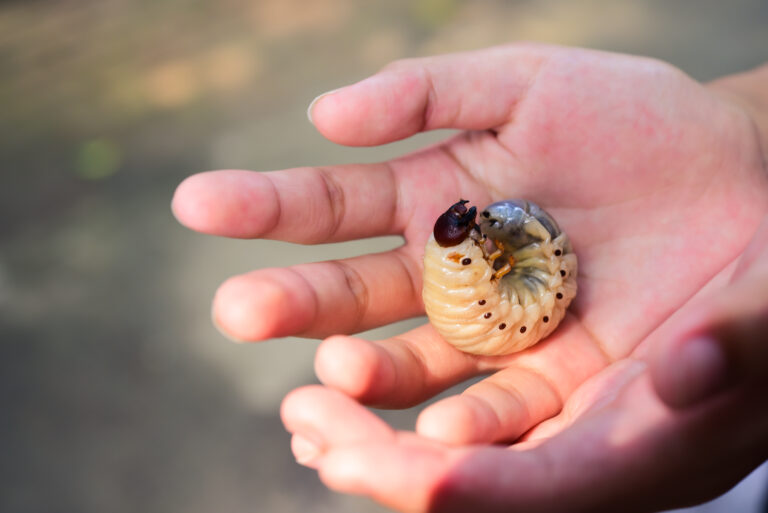
Grubs in New Jersey
Grubs are the larval stage of beetles that feed on the roots of turfgrass, causing thinning, brown patches, and weakened lawns.
Common Grub Species in NJ
- Japanese beetle (Popillia japonica)
- Most common grub in New Jersey.
- Larvae feed on turf roots in late summer and early fall.
- Adults emerge in June–July, feeding on leaves of ornamental plants and turf.
- June/May beetles (Phyllophaga spp.)
- Larvae feed on turf roots throughout summer.
- Adults are active in late spring and early summer.
- European chafer (Amphimallon majale)
- Less common but aggressive root feeders.
- Adults active in early summer, larvae feed in late summer.
Signs of Grub Damage in Lawns
Grubs feed on the roots of turfgrass, which weakens the lawn and causes visible symptoms. The damage may initially be subtle but becomes more noticeable as the infestation grows. Common signs include:
- Irregular brown or thinning patches
- Grub feeding often causes patchy areas rather than uniform damage.
- Affected areas may appear yellowing at first, then turn brown as the grass loses access to water and nutrients.
- Patches can range from a few square inches to several square feet and often expand over time.
- Turf that pulls up easily
- When roots are eaten, the grass loses its anchorage.
- Lawn sections can often be lifted like a carpet, revealing white or cream-colored C-shaped grubs just below the soil surface.
- This symptom is a clear indication of active larval feeding.
- Animals digging in the lawn
- Skunks, raccoons, birds, and other wildlife are attracted to grubs as a food source.
- If you notice irregular digging or uprooted grass, it’s often a secondary sign of grub presence.
- Grass that wilts or dies even with proper watering
- Grub damage reduces root function, so grass cannot take up water efficiently, even during adequate irrigation or rainfall.
- Wilting often appears in isolated spots and can be mistaken for drought stress or other lawn problems.
- Slow growth and thinning
- Lawns infested with grubs may grow more slowly than surrounding healthy turf.
- Over time, this leads to thinner turf coverage, making the lawn more vulnerable to weeds and environmental stress.
- Timing of symptoms
- In New Jersey, damage is most apparent late summer to early fall, when grubs are actively feeding near the soil surface.
- Overwintering grubs are deeper in the soil, so early-season damage may be minimal.
Grub Lifecycle (Estimated NJ Timetable)
Stage | Approx. Timing | Notes |
Eggs | July – August | Laid by adult beetles in soil; white, small, and spherical |
Larvae (Grubs) | Late August – October | Feed actively on grass roots near soil surface; lawn damage appears |
Overwintering Larvae | November – March | Move deeper into soil to survive cold winter temperatures |
Resume Feeding | April – May | Move closer to surface as soil warms, feed lightly |
Pupation | Late May – June | Transform into adult beetles underground |
Adults | June – July | Feed on leaves of plants, mate, and lay eggs for next generation |
Note: This timetable is estimated. Local weather, soil temperature, and lawn conditions can shift exact timing.